
TL;DR:
- Autism therapy must be customized to meet each child’s unique strengths, challenges, and co-occurring conditions. Buildingblockresolutions emphasizes individualized treatment plans and interdisciplinary care to improve therapy outcomes. Maintaining reasonable caseload ratios and involving caregivers are essential for effective, personalized autism support.
Individualized therapy for autism is defined as a treatment approach tailored to each child’s unique strengths, challenges, communication style, and co-occurring conditions. This is why autism therapy requires customization: no two children on the spectrum present identically, and a one-size-fits-all program fails to address what each child actually needs. Applied Behavior Analysis (ABA) therapy, the most evidence-based intervention for autism spectrum disorder, depends on this personalization to produce real gains in communication, social interaction, and daily living skills. Buildingblockresolutions has built its entire model around this principle, backed by over 20 years of clinical experience.
Why autism therapy requires customization: the spectrum is not one thing
Autism spectrum disorder is not a single condition with a predictable set of traits. Autism presents vast diversity in how individuals communicate, behave, and experience the world, which means a single treatment model cannot serve every child well. One child may use full sentences but struggle intensely with transitions. Another may have no spoken language but excel at visual problem-solving. These two children need entirely different goals, methods, and pacing.
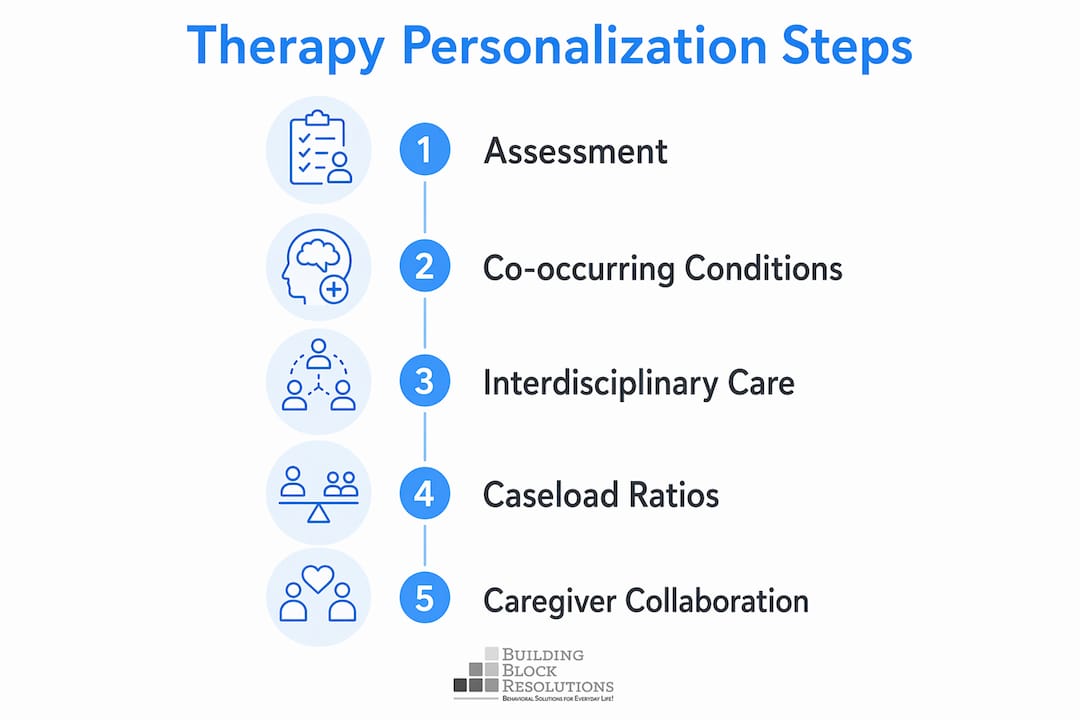
The differences go beyond communication style. Children with autism frequently experience co-occurring conditions that directly affect their behavior and progress in therapy. These include:
- Gastrointestinal issues that cause discomfort and increase irritability during sessions
- Sleep disturbances that reduce attention, emotional regulation, and learning capacity
- Sensory sensitivities that make certain environments or materials intolerable
- Anxiety or mood disorders that shape how a child responds to demands and transitions
- Motor delays that affect participation in certain skill-building activities
Each of these factors changes what a therapy session should look like. A child who slept three hours the night before needs a different approach than a child who is well-rested and regulated. Assessing each child’s full profile, including medical, behavioral, and developmental factors, is the starting point for any effective individualized therapy plan.
How interdisciplinary care models improve personalized therapy outcomes

The field of autism intervention has shifted away from rigid single-paradigm models toward integrated, multimodal care. This shift is grounded in clinical evidence, not preference. When behavioral, developmental, and medical therapies are coordinated under one care plan, children show better adaptive behavior outcomes than they do under fragmented care.
The most effective integrative models combine several disciplines working in alignment:
- ABA therapy targeting specific behavioral goals and skill acquisition
- Speech-language therapy addressing communication, language processing, and social use of language
- Occupational therapy building fine motor skills, sensory regulation, and daily living independence
- Medical oversight from a neurodevelopmental physician who addresses physiological factors affecting behavior
A neurodevelopmental physician-coordinated approach ensures that behavioral and medical therapies reinforce each other rather than work at cross-purposes. For example, if a child’s aggression is partly driven by untreated GI pain, no amount of behavioral intervention alone will produce lasting change. Addressing the medical root cause alongside the behavioral goals produces faster, more durable progress.
Multimodal care also addresses co-occurring physiologic symptoms like gastrointestinal distress and sleep disorders that directly impair behavioral progress. This is why parents seeking care for children with complex presentations should ask whether their provider coordinates with medical specialists, not just behavioral therapists. For families navigating these medical and behavioral intersections, resources like autism care for teens and young adults illustrate how personalized healthcare planning addresses the full picture.
Pro Tip: Ask any prospective therapy provider whether they communicate regularly with your child’s pediatrician or specialists. Coordination between providers is a concrete sign that care is truly individualized.
How caseload ratios affect the quality of individualized care
Customized autism treatment requires time. A therapist cannot write a genuinely individualized protocol, review data weekly, and adjust goals in real time if they are managing too many clients at once. A reasonable caseload ratio is approximately 8 clients per supervisor for quality ABA therapy. That number exists because genuine customization demands regular observation, data analysis, and protocol revision.
The problem is that some agencies operate at ratios far beyond this standard.
When analyst-to-client ratios stretch as high as 40:1, the time required for individualized data review and protocol adjustment simply does not exist. The result is cookie-cutter programming that reflects scheduling convenience rather than each child’s clinical needs.
At inflated ratios, continuous data-based supervision breaks down. Without regular observation and retraining, therapists drift from the individualized protocol. This is called treatment drift, and it means your child may be receiving a generic program even if the paperwork says otherwise.
The table below shows how caseload ratios affect the practical quality of individualized care.
| Caseload ratio | Weekly data review | Protocol adjustment | Customization quality |
|---|---|---|---|
| 8:1 (recommended) | Feasible every session | Responsive and timely | High |
| 15:1 | Possible but strained | Delayed | Moderate |
| 40:1 | Rarely achievable | Infrequent or absent | Low |
Voluntary accreditation is one of the clearest signals a family can look for when evaluating a provider. Accredited agencies tend to maintain reasonable caseloads, document procedural integrity, and invest in ongoing analyst training. These are not just administrative checkboxes. They are the structural conditions that make real customization possible.
Parents should also know that generic high-hour plans without individual assessment may reflect business decisions rather than clinical need. Not every child benefits from maximum therapy hours. Intensity must match the child’s current capacity, goals, and family situation. A provider who recommends the same number of hours for every child is not practicing individualized care.
Why caregiver collaboration is essential to personalized therapy
Therapy does not end when your child leaves the session. Family participation improves therapy engagement and outcomes by creating consistent reinforcement across home and therapy settings. A skill practiced only in a clinic rarely generalizes to real life. When caregivers understand the goals and methods, they can reinforce progress during meals, bedtime routines, and community outings.
Caregiver collaboration also shapes the goals themselves. Parents know their child’s preferences, triggers, and daily rhythms in ways that no clinician can fully observe in a session. When therapists incorporate that knowledge, goals become more relevant and motivating for the child. A child who loves trains will engage far more readily with a communication goal framed around train vocabulary than one built around abstract objects.
- Share your child’s daily routine with the therapy team so goals align with real-life contexts
- Report changes at home such as sleep disruptions, dietary shifts, or new stressors that may affect session behavior
- Ask for parent coaching as part of the therapy plan so you can apply strategies consistently
- Communicate about communication. If your child uses gestures, pictures, or a device to express needs, the therapy approach should honor and build on that method, not replace it
Individualized therapy honors each child’s uniqueness by leveraging strengths and addressing specific challenges, which promotes engagement and motivation. A child who feels understood and respected in therapy participates more fully. That participation is what drives skill acquisition.
Pro Tip: Request a monthly caregiver meeting with your child’s lead therapist. Use it to review data, ask questions, and update the team on anything new at home. This single habit keeps the plan genuinely individualized over time.
You can learn more about how ABA therapy and collaboration work together to produce better outcomes for children and families.
Key Takeaways
Autism therapy requires customization because each child’s unique profile of strengths, challenges, co-occurring conditions, and family context determines which goals, methods, and intensity levels will actually produce progress.
| Point | Details |
|---|---|
| Autism is not one thing | Each child presents differently, requiring individual assessment before any plan is written. |
| Interdisciplinary care improves outcomes | Coordinating ABA, speech, occupational, and medical therapies produces better adaptive behavior results than fragmented care. |
| Caseload ratios matter | Ratios above 15:1 make weekly data review and genuine protocol adjustment impractical. |
| Accreditation signals quality | Accredited providers are more likely to maintain reasonable caseloads and procedural fidelity. |
| Caregiver involvement sustains progress | Family participation in goal-setting and home reinforcement is what makes clinic gains transfer to real life. |
What I’ve learned after years of watching families navigate autism therapy
After working in and around ABA therapy for a long time, the pattern I see most often is this: families accept the first plan they are offered because they are exhausted and relieved to have any support at all. That is completely understandable. But the first plan is not always the right plan.
The families who see the most progress are the ones who ask hard questions early. They ask about caseload ratios. They ask how often the protocol gets reviewed. They ask whether the goals connect to what their child actually cares about. These questions are not adversarial. They are the sign of a parent who understands that choosing an ABA therapy provider is one of the most consequential decisions they will make for their child.
Customization is not a luxury feature. It is the clinical standard. A plan that does not change as your child grows and changes is not a personalized plan. It is a template. The best providers treat data review and goal revision as core clinical duties, not administrative burdens.
My honest advice: seek accredited providers, ask about caseloads on your first call, and insist on being included in the goal-setting process. Your knowledge of your child is not supplementary. It is central to the plan working.
— Jennifer
How Buildingblockresolutions supports individualized autism therapy
Buildingblockresolutions was built on the belief that every child deserves a therapy plan written specifically for them. With over 20 years of experience and a team dedicated to ABA therapy, Buildingblockresolutions creates individualized treatment plans that reflect each child’s strengths, challenges, and family context.

Parent coaching is woven into every program so that progress made in sessions carries into daily life at home. Over 90% of children in Buildingblockresolutions programs achieve significant advancements, a result that comes directly from treating customization as a non-negotiable standard. Start with the ABCs of behavior analysis to build your foundation, or read the clear guide to ABA therapy for parents to understand what a truly individualized program looks like in practice.
FAQ
Why can’t one therapy approach work for all children with autism?
Autism presents differently in every individual, with unique communication styles, co-occurring conditions, and sensory profiles. A single approach cannot address this range of needs effectively.
What is a safe analyst-to-client caseload ratio in ABA therapy?
A reasonable ratio is approximately 8 clients per supervisor. Ratios above 15:1 make individualized data review and weekly protocol adjustment impractical.
How does caregiver involvement improve therapy outcomes?
Family participation creates consistent reinforcement across home and therapy settings, which helps skills generalize to real life and keeps goals relevant to the child’s daily experience.
What should I look for to confirm a provider offers truly individualized care?
Ask about caseload ratios, how often protocols are reviewed, and whether the agency holds voluntary accreditation. These factors directly determine whether customization is possible in practice.
How do co-occurring conditions affect autism therapy planning?
Conditions like GI issues and sleep disturbances directly impair attention and emotional regulation, so an individualized plan must account for these factors alongside behavioral goals.
0 Comments