
TL;DR:
- Special education teachers for autism develop individualized programs that focus on academic, behavioral, and social goals using evidence-based methods. They collaborate closely with families and support staff to ensure consistent communication, cultural sensitivity, and effective strategy implementation. Their role extends beyond instruction to include case management, legal compliance, and active partnership building.
The role of special education teacher for autism is defined as delivering individualized academic, behavioral, and social support to students on the autism spectrum through legally mandated Individualized Education Programs (IEPs) and evidence-based strategies. These teachers operate at the intersection of education, behavioral science, and family partnership. They are not simply classroom instructors. They are case managers, advocates, and collaborators who manage caseloads under IDEA while tailoring every goal to each student’s unique profile. Understanding this role fully helps educators, parents, and support staff work together more effectively for every child they serve.
What are the core responsibilities of special education teachers for autism?
Special education teachers working with autistic students carry a wide range of duties that go far beyond lesson planning. Their responsibilities span instruction, behavior management, legal compliance, and ongoing communication with families and support teams.
The core duties break down into five areas:
-
Develop and implement IEP goals. Every autistic student receives an IEP that outlines measurable academic, functional, and social objectives. The teacher writes these goals, tracks progress, and revises them at least annually per federal mandate.
-
Deliver adapted academic instruction. Lessons are modified to match each student’s learning profile, sensory needs, and communication style. A student who processes information visually may receive picture-based schedules alongside written text.
-
Apply evidence-based behavior strategies. ABA principles in classrooms guide how teachers structure reinforcement, reduce problem behaviors, and build functional routines. These methods are not optional add-ons. They are the backbone of effective autism instruction.
-
Monitor progress and document rigorously. Teachers collect data on IEP goals and Behavioral Intervention Plans (BIPs) on a weekly or bi-weekly cycle. This documentation must be legally defensible if a family or district questions service delivery.
-
Manage caseloads within federal and state limits. Caseload size varies by state, but every teacher must balance individualized attention with administrative obligations under IDEA.
A common misconception is that the teacher’s focus is primarily academic. In reality, functional skills and behavioral regulation are often the primary focus for autistic students. Reading and math matter, but so does learning to request a break, tolerate a change in routine, or greet a peer appropriately.
Pro Tip: Keep a shared digital folder for each student’s data sheets and IEP progress notes. This makes annual review meetings faster and gives families real-time visibility into their child’s growth.
How do special education teachers collaborate with families and support staff?
Effective collaboration is not a soft skill for autism teachers. It is a professional requirement that directly shapes student outcomes. Parental involvement and positive communication significantly impact educational success for students with autism. That finding carries a clear implication: teachers who invest in family relationships produce better results than those who limit contact to required meetings.
A 2025–26 study of lead special education teachers identified four key communication themes that define strong family engagement:
- Transparency. Families receive consistent updates on progress, challenges, and strategy changes. No surprises at IEP meetings.
- Active listening. Teachers ask questions and genuinely incorporate family knowledge into the student’s program.
- Cultural sensitivity. Families come from diverse backgrounds with different expectations, communication styles, and beliefs about disability. Culturally responsive strategies build trust even when language barriers or differing expectations exist.
- Collaborative partnership. Families are treated as experts on their own children, not as passive recipients of professional decisions.
“The teacher’s role has evolved to include cultural mediator and collaborative partner with families. Partnership success depends on the teacher’s relational skills as much as pedagogical expertise.” — Lived Experience Research, RSIS International
Collaboration also extends beyond families. Special education teachers coordinate daily with paraprofessionals, speech-language pathologists, occupational therapists, and school psychologists. Clear communication protocols across this team prevent inconsistent strategies that confuse students. The Three Cs framework — Consider, Communicate, Connect — gives teachers a practical structure for moving beyond compliance-level contact toward authentic partnership. It centers family expertise, honors cultural needs, and builds scaffolded advocacy support over time.
Pro Tip: Schedule brief weekly check-ins with paraprofessionals rather than relying on end-of-day notes. Real-time feedback catches behavioral patterns before they escalate.

What specialized strategies do autism teachers use in the classroom?
Special education autism strategies are the practical tools teachers use to make learning accessible and behavior manageable for autistic students. These strategies are not one-size-fits-all. They are selected based on each student’s sensory profile, communication level, and behavioral needs.
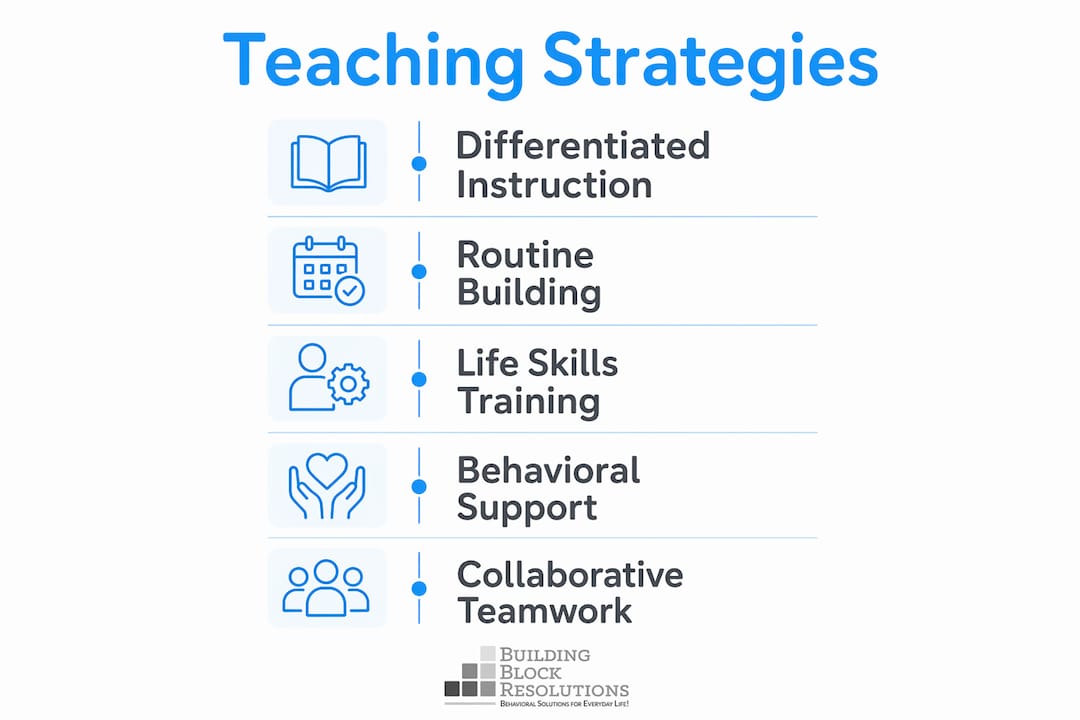
The table below compares four major strategy categories by purpose and application:
| Strategy | Primary Purpose | Classroom Application |
|---|---|---|
| Differentiated instruction | Adapt content to learning style | Visual schedules, tiered assignments, hands-on tasks |
| Applied Behavior Analysis (ABA) | Build skills and reduce problem behavior | Discrete trial training, reinforcement systems, task analysis |
| Social communication supports | Develop pragmatic language | Social stories, role-play scripts, peer-mediated interaction |
| Assistive technology | Increase access and independence | AAC devices, text-to-speech tools, visual timers |
Routine building deserves special attention. Autistic students often rely on predictable sequences to regulate their anxiety and attention. A teacher who structures the school day with consistent transitions, visual cues, and advance warnings for changes gives students the scaffolding they need to engage with learning content. Disrupting that routine without preparation is one of the fastest ways to trigger a behavioral crisis.
Functional life skills training rounds out the instructional picture. Skills like managing personal belongings, following multi-step directions, and navigating social situations in the cafeteria are taught explicitly. These skills do not develop incidentally for many autistic students. They require the same structured instruction as reading or math. Resources on neurodiverse support across settings confirm that consistent strategy application across school, home, and community settings produces the strongest outcomes.
How does IDEA shape the responsibilities of autism teachers?
The Individuals with Disabilities Education Act (IDEA) is the federal law that defines what special education teachers must do, when they must do it, and how they must document it. IDEA compliance is not bureaucratic overhead. It is the legal foundation that protects every autistic student’s right to a free appropriate public education (FAPE).
| IDEA Requirement | Teacher Responsibility | Timeline |
|---|---|---|
| Initial evaluation | Participate in assessment and eligibility determination | Within 60 days of referral (varies by state) |
| IEP development | Write goals, accommodations, and placement recommendations | Before services begin |
| Annual IEP review | Update goals and measure progress | Every 12 months |
| Triennial reevaluation | Reassess eligibility and current levels | Every 3 years |
| BIP documentation | Collect and analyze behavioral data | Weekly or bi-weekly |
Teachers act as case managers who navigate all of these timelines simultaneously. Missing a deadline does not just create paperwork problems. It can expose the district to due process complaints and, more importantly, delay services a student needs. Procedural safeguards under IDEA also give families the right to challenge decisions, request independent evaluations, and participate fully in every IEP meeting. The teacher’s role includes explaining these rights clearly and making sure families feel genuinely included in the process.
Data collection obligations under IDEA are substantial. Teachers must document progress on every IEP goal at each reporting period and maintain BIP data that demonstrates whether behavioral interventions are working. This level of documentation requires organized systems and consistent daily habits.
How has the role of autism teachers evolved, and what works today?
The responsibilities of autism teachers have shifted significantly over the past two decades. The position once centered almost entirely on classroom instruction and compliance paperwork. Today, the role integrates clinical skills, cultural mediation, and partnership facilitation. That shift reflects a deeper understanding of what actually moves the needle for autistic students.
Practical advice from experienced practitioners points to several best practices that define effective autism teachers today:
- Build trust with families before problems arise. Introduce yourself at the start of the year, share something positive about the student early, and establish a communication routine before the first IEP meeting.
- Invest in ongoing professional development. The research base for autism education evolves quickly. Teachers who stay current with ABA updates, sensory processing research, and augmentative communication advances serve their students better.
- Balance compliance with individualized care. Documentation matters, but it should never crowd out the time spent actually teaching and connecting with students.
- Develop emotional intelligence alongside pedagogical skills. Autistic students and their families often arrive with histories of frustration and unmet expectations. A teacher who responds with patience and genuine curiosity changes that experience.
- Use ABA therapy collaboration frameworks to align school and home strategies. Consistency across settings accelerates skill generalization.
Pro Tip: Ask families one question at every IEP meeting: “What is one thing you wish the school understood better about your child?” The answers will reshape your approach more than any assessment.
Key Takeaways
The role of special education teacher for autism requires simultaneous mastery of individualized instruction, behavioral science, legal compliance, and family partnership.
| Point | Details |
|---|---|
| IEPs are the legal and instructional foundation | Teachers write, implement, and annually review IEP goals tailored to each student’s academic, functional, and social needs. |
| ABA principles drive behavior and skill development | Applied Behavior Analysis structures reinforcement, routine building, and social communication supports in the classroom. |
| Family collaboration is a professional requirement | Transparent, culturally sensitive communication with caregivers directly improves student outcomes. |
| IDEA compliance shapes every teacher responsibility | Federal timelines for evaluations, IEP reviews, and BIP data collection are legally binding obligations. |
| The role has expanded beyond instruction | Today’s autism teachers also serve as cultural mediators, case managers, and family advocates. |
What I’ve learned about this role after years of watching it up close
The thing that surprises most people when they first encounter a skilled special education teacher for autism is how little of the job looks like traditional teaching. The most effective practitioners I’ve observed spend as much energy on relationships as they do on lesson plans. They know which student needs five minutes of quiet before transitioning to a new task. They know which parent needs a phone call rather than an email. That relational intelligence is not something a certification program fully teaches. It develops through experience, reflection, and a genuine commitment to each child’s dignity.
What I find most encouraging is the growing recognition that families are not just stakeholders to be informed. They are partners who hold irreplaceable knowledge about their children. Teachers who treat IEP meetings as collaborative conversations rather than presentations consistently report stronger family trust and better student progress. That shift in mindset costs nothing and changes everything.
The compliance burden is real, and I won’t minimize it. Weekly data collection, annual reviews, and triennial evaluations consume significant time. The teachers who handle this best build simple, repeatable systems early in the year. They do not wait for a due process complaint to get organized. They treat documentation as a professional habit, not a crisis response.
My honest belief is that the future of this role belongs to educators who combine behavioral expertise with cultural humility. The families walking into IEP meetings come from every background imaginable. A teacher who can honor that diversity while holding firm to evidence-based practice is the one who will make a lasting difference.
— Jennifer
How Buildingblockresolutions supports educators and families
Buildingblockresolutions brings over 20 years of ABA expertise to families and educators who want more than a classroom strategy. Their individualized programs address communication, social interaction, and daily living skills with the same evidence-based rigor that defines strong special education practice.

Whether you are a parent trying to understand what your child’s teacher is doing and why, or an educator looking to align school strategies with home support, Buildingblockresolutions offers resources that make that connection clear. Their ABA therapy guide for parents explains the behavioral principles behind classroom strategies in plain language. Families can also explore parent coaching sessions designed to build consistent, supportive environments at home. Over 90% of children in their programs achieve significant progress, backed by a dedicated team that treats every family as a true partner.
FAQ
What is the primary role of a special education teacher for autism?
The primary role is to develop and implement individualized education programs (IEPs) that address each autistic student’s academic, behavioral, and social needs using evidence-based strategies like Applied Behavior Analysis.
How do special education teachers use ABA in the classroom?
Teachers apply ABA principles through reinforcement systems, discrete trial training, task analysis, and routine building to develop functional skills and reduce problem behaviors in autistic students.
What legal requirements govern special education teachers for autism?
IDEA requires teachers to manage IEP timelines, conduct annual reviews, collect behavioral data for BIPs, and uphold procedural safeguards that protect each student’s right to a free appropriate public education.
How can parents best collaborate with their child’s special education teacher?
Parents build the strongest partnerships by attending IEP meetings prepared with observations from home, asking questions openly, and establishing a consistent communication routine with the teacher throughout the school year.
What strategies do autism teachers use beyond academic instruction?
Autism teachers use social stories, assistive technology, visual schedules, sensory accommodations, and functional life skills training to support the full range of each student’s developmental needs.
0 Comments