TL;DR:
- School district BCBA roles vary because districts interpret the position differently and align it with local frameworks. Their responsibilities shift from direct intervention to staff coaching and systems work based on district policies and support structures. IDEA funding changes accountability by making BCBAs answer to educational laws and IEP requirements rather than insurance, which influences documentation and authority.
School district BCBA roles differ because districts define the position differently, align Applied Behavior Analysis with local educational frameworks, and provide varying levels of staffing support. The Board Certified Behavior Analyst credential is consistent nationwide, but the job itself changes dramatically depending on where a BCBA works. A 2024 survey of school-based behavior analysts identifies district-level definitions, alignment with frameworks like PBIS and MTSS, and available support structures as the primary variables shaping daily responsibilities. Understanding why school district BCBA roles differ helps administrators place these professionals where they create the most impact, and helps educators collaborate with them more effectively.

Why school district BCBA roles differ at the district level
The most direct cause of BCBA responsibilities variation is that no federal law formally defines what a BCBA must do inside a school. IDEA mandates behavioral services as part of a Free Appropriate Public Education, but it does not specify the BCBA’s job title, caseload, or scope. That gap leaves each district to write its own definition.
The result is a wide range of role assignments across districts:
- Crisis intervention specialist: The BCBA responds to acute behavioral incidents and manages restraint or de-escalation protocols.
- Behavior consultant: The BCBA assesses individual students, writes behavior intervention plans, and advises teachers on implementation.
- Systems coach: The BCBA trains staff, builds district-wide behavioral capacity, and integrates ABA principles into school-wide programs.
- Direct interventionist: The BCBA delivers one-on-one ABA sessions, functioning similarly to a clinical role.
The absence of a codified IDEA role for BCBAs creates ongoing role ambiguity and responsibility negotiation within districts. That ambiguity means a BCBA hired in one district may spend 80% of their time on staff training, while a BCBA in a neighboring district spends the same proportion on individual student sessions.
District leadership’s understanding of ABA also shapes the role significantly. Administrators who view BCBAs primarily as crisis responders assign reactive, student-facing tasks. Those who understand the systems-level value of BCBAs assign proactive, capacity-building work that affects far more students. The contracting versus direct-hire model adds another layer. Contracted BCBAs often have narrower, pre-negotiated scopes, while direct hires absorb whatever the district needs.
Pro Tip: Define your scope of practice in writing before your first day. A clear role agreement prevents assignment creep and protects both the BCBA and the students they serve.
How do PBIS and MTSS shape BCBA job functions?
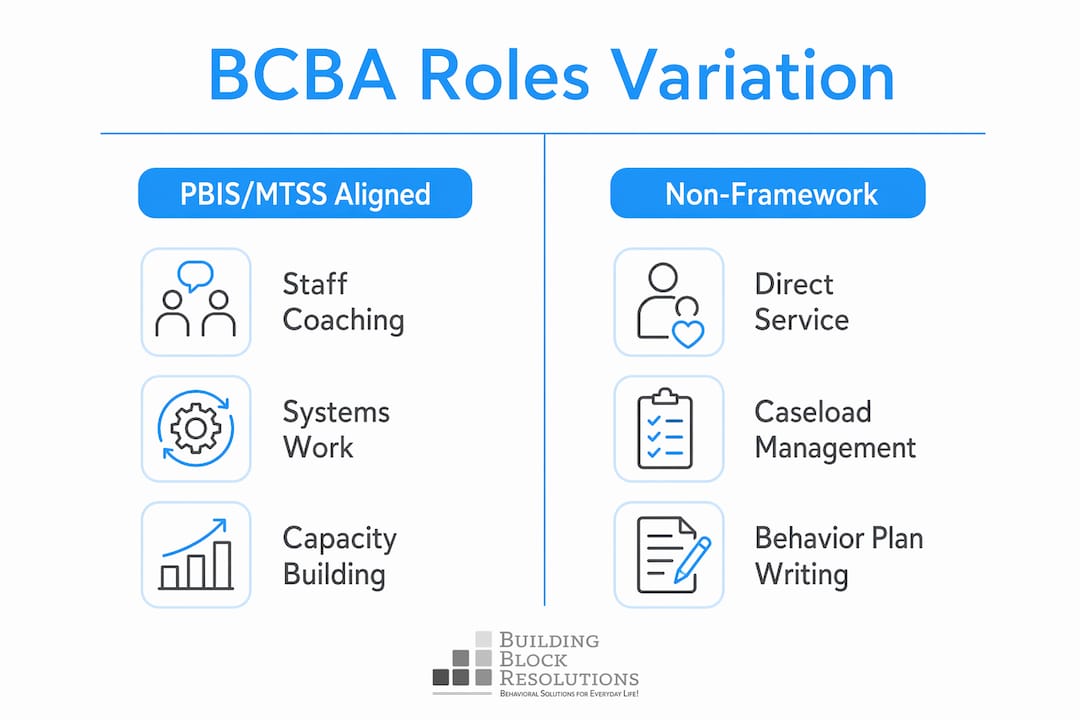
Positive Behavioral Interventions and Supports (PBIS) and Multi-Tiered System of Supports (MTSS) are the two dominant behavioral frameworks in American public schools. Both organize support into tiers: universal prevention, targeted group intervention, and intensive individual support. When a district runs a strong PBIS or MTSS program, the BCBA’s role shifts toward systems-level partnership rather than direct therapy.
School BCBAs in framework-aligned districts spend most of their time coaching adults and building staff capacity, not delivering direct student sessions. That shift is intentional. One trained teacher who implements behavior strategies correctly affects 25 students daily. One BCBA working directly with a single student affects one. The math favors the coaching model.
The contrast with clinical ABA is sharp. Clinical BCBAs carry direct service caseloads, write programs for one-on-one technician delivery, and bill by the hour. School BCBAs in PBIS-aligned districts function more like Organizational Behavior Management (OBM) consultants, using data systems, staff feedback loops, and environmental design to change behavior at scale.
| BCBA activity | PBIS/MTSS-aligned district | Non-framework district |
|---|---|---|
| Staff training and coaching | High (40–60% of time) | Low (10–20% of time) |
| Direct student intervention | Low (10–20% of time) | High (50–70% of time) |
| IEP team consultation | Moderate (20–30% of time) | Moderate (20–30% of time) |
| Data system development | High (20–30% of time) | Low (5–10% of time) |
Schools that prioritize curriculum access and social participation require BCBAs to shift toward educational collaboration rather than clinical skill acquisition. That mindset shift is one of the most significant school district BCBA differences a behavior analyst encounters when moving from a clinic to a school.
How does IDEA funding change BCBA accountability?
IDEA fundamentally changes who the BCBA answers to and what they document. In a clinical setting, a BCBA answers to an insurance payer’s billing requirements. In a school, the BCBA answers to educational law, district policy, and the IEP team.
BCBA-led services in schools are provided free under IDEA as a component of FAPE. That single fact changes the entire accountability structure. There are no billable units, no authorization limits, and no insurance denials. Instead, there are IEP goals, progress reports, and legal timelines.
The practical differences in accountability include:
- IEP involvement: School BCBAs contribute to legally binding documents. Every behavioral goal they write becomes part of a student’s IEP and carries legal weight.
- Documentation standards: Notes follow educational record requirements under FERPA, not clinical documentation standards used in insurance-funded settings.
- Scope of authority: School BCBAs recommend behavioral plans but rarely hold final decision-making authority. The IEP team, which includes parents, teachers, and administrators, approves all plans.
- Ethical boundaries: Multiple relationships are unavoidable in schools. A BCBA may supervise a paraprofessional, consult with that paraprofessional’s classroom teacher, and attend the same IEP meeting as the student’s parent, all in one day.
The lack of a formal federal IDEA role for BCBAs means districts interpret these boundaries differently. Some districts grant BCBAs significant authority over behavioral programming. Others treat them as one voice among many with no special weight. That variation directly explains why BCBA job functions comparison across districts produces such different results.
Pro Tip: Review your district’s special education policies before writing any behavioral plan. Knowing the legal framework prevents ethical conflicts and keeps your recommendations enforceable.
How do support structures shape BCBA responsibilities across districts?
The organizational context of a district shapes BCBA daily work as much as any policy or framework. Districts with strong BCBA staffing ratios allow each behavior analyst to specialize. Districts with thin staffing force BCBAs to cover everything, from individual assessments to staff training to crisis response, often simultaneously.
Supervision authority varies widely as well. Some districts give BCBAs direct supervisory responsibility over paraprofessionals and behavior technicians. Others place paraprofessionals under the classroom teacher’s authority, leaving the BCBA to influence without formal power. Effective school-based BCBAs rely on Organizational Behavior Management skills precisely because they often must create change without formal supervisory authority.
The multidisciplinary IEP team structure adds complexity that clinical roles rarely face. Consider what a school BCBA navigates in a single IEP meeting:
“BCBAs in schools participate on multidisciplinary IEP teams where decisions are shared. This team-based structure requires balancing clinical recommendations with legal mandates, building schedules, and administrative priorities. BCBAs rarely hold ultimate authority on student plans and must navigate complex hierarchies involving administrators, legal frameworks, and teachers.”
Administrative support culture shapes the role further. A principal who values behavioral science creates space for the BCBA to coach teachers, run data reviews, and build systems. A principal who views the BCBA as a specialist called in for emergencies limits that same professional to reactive work. The educational collaborator mindset that effective school BCBAs develop is partly a response to these organizational realities.
For administrators, the lesson is direct. The support structure you build around your BCBA determines what that professional can accomplish. Providing collaborative time, administrative backing, and clear supervisory lines multiplies the BCBA’s impact across the entire district. You can explore how BCBA work settings compare across school and clinical contexts to understand what conditions produce the best outcomes.
Key Takeaways
School district BCBA roles differ because districts define the position without federal guidance, align it with local frameworks like PBIS and MTSS, and provide widely varying levels of staffing and administrative support.
| Point | Details |
|---|---|
| No federal role definition | IDEA mandates behavioral services but does not define the BCBA’s specific duties, leaving districts to set their own expectations. |
| Framework alignment shifts focus | Districts running PBIS or MTSS programs move BCBAs toward staff coaching and systems work rather than direct student therapy. |
| IDEA changes accountability | School BCBAs answer to educational law and IEP teams, not insurance billing, which reshapes documentation and authority. |
| Support structures determine scope | Staffing ratios, supervisory authority, and administrative culture directly control what a BCBA can accomplish each day. |
| Proactive role definition matters | BCBAs and administrators who define scope in writing before work begins prevent ethical conflicts and role creep. |
What I’ve learned about BCBA role variation in schools
After working closely with school-based behavior analysts and district administrators, the pattern I see most often is this: districts that treat BCBAs as crisis responders get crisis responders. Districts that treat BCBAs as systems partners get something far more valuable.
The most effective BCBAs I have observed spend relatively little time in direct student sessions. They spend their time training teachers, reviewing data with teams, and building the kind of school-wide behavioral culture that prevents crises from happening in the first place. That is not a lesser version of the BCBA role. That is the role at its most powerful.
Administrators often underestimate how much the organizational context they create shapes BCBA effectiveness. A BCBA placed in a district with no supervisory authority, no collaborative planning time, and no administrative backing will struggle to move the needle regardless of their clinical skill. The ABA funding model a district operates under also constrains or expands what is possible.
My strongest recommendation for any administrator reading this: sit down with your BCBA and write out the role together. Define the caseload, the supervisory relationships, the IEP responsibilities, and the time allocated to staff training. That conversation, done once and done well, prevents months of confusion and protects the students who depend on clear, consistent behavioral support.
— Jennifer
How Buildingblockresolutions supports districts and educators
Buildingblockresolutions brings over 20 years of Applied Behavior Analysis expertise to families, educators, and administrators who want clear, practical guidance on behavioral support. Whether you are trying to understand how ABA principles apply in educational settings or looking to strengthen the behavioral programs in your district, Buildingblockresolutions offers resources built on evidence and real-world experience.
The team at Buildingblockresolutions specializes in individualized behavioral programming, parent coaching, and consultation that connects clinical ABA knowledge to educational realities. For educators and administrators who want a deeper foundation, the ABCs of behavior analysis guide offers a clear starting point. You can also explore positive behavior support strategies with real examples drawn from practice. Buildingblockresolutions is ready to help your team build the behavioral capacity that students deserve.
FAQ
Why do BCBA responsibilities vary so much between districts?
Role variation is driven by district-level definitions, alignment with frameworks like PBIS and MTSS, and available support structures. IDEA mandates behavioral services but does not define the BCBA’s specific duties, so each district sets its own expectations.
What is the difference between a school BCBA and a clinical BCBA?
School BCBAs function primarily as consultants who collaborate with educators and IEP teams, while clinical BCBAs carry direct service caseloads. School roles involve more staff training, IEP participation, and systems-level work.
How does IDEA affect what a school BCBA does?
IDEA requires that behavioral services be provided free as part of FAPE, which means school BCBAs answer to educational law and district policy rather than insurance billing requirements. This changes documentation standards, scope of authority, and IEP accountability.
Should districts use BCBAs for crisis intervention or systems work?
Experts identify BCBAs as preventative systems partners whose greatest impact comes from coaching adults and building school-wide behavioral capacity, not from responding to crises. Districts that limit BCBAs to crisis response underuse a significant professional resource.
Do school BCBAs earn less than clinical BCBAs?
School-based BCBAs generally earn lower base salaries than clinical BCBAs but benefit from pension plans, job stability, and a school-calendar schedule. The compensation structure reflects a 10-month work year and public-sector benefits rather than clinical billing rates.
0 Comments