
TL;DR:
- Ethics in behavior analysis is a principles-based framework guiding all professional decisions to prioritize client welfare, dignity, integrity, and competence.
- Most violations stem from documentation and supervision failures often caused by high workloads rather than misconduct.
- Structured ethical decision-making and ongoing dialogue foster an organizational culture that emphasizes accountability and professional growth.
Ethics in behavior analysis is defined as the principled framework that governs every professional decision a behavior analyst makes, from direct client care to supervision, research, and public communication. The 2022 BACB Ethics Code shifted the field from a rules-only model to a principles-based approach, requiring practitioners to reason from four core values rather than simply check boxes. The role of ethics in behavior analysis is not a background concern. It shapes every interaction, every treatment decision, and every professional relationship. Violating ethical standards carries consequences ranging from license suspension to lasting harm to the clients behavior analysts are trusted to serve.
What is the role of ethics in behavior analysis?
The 2022 Ethics Code organizes all professional obligations under four core principles: benefit others, treat others with compassion and dignity, behave with integrity, and ensure competence. These principles do more than define acceptable conduct. They provide a reasoning scaffold for situations where no specific rule applies. Understanding how ABA differs from psychology helps clarify why behavior analysis requires its own distinct ethical framework grounded in these four values.

Benefit others
Benefiting others means every intervention, recommendation, and professional action must improve outcomes for clients and the people around them. This principle places client welfare above organizational convenience, billing pressures, or personal preference. A behavior analyst who recommends an intervention with weak evidence simply because it is faster to implement violates this principle directly.
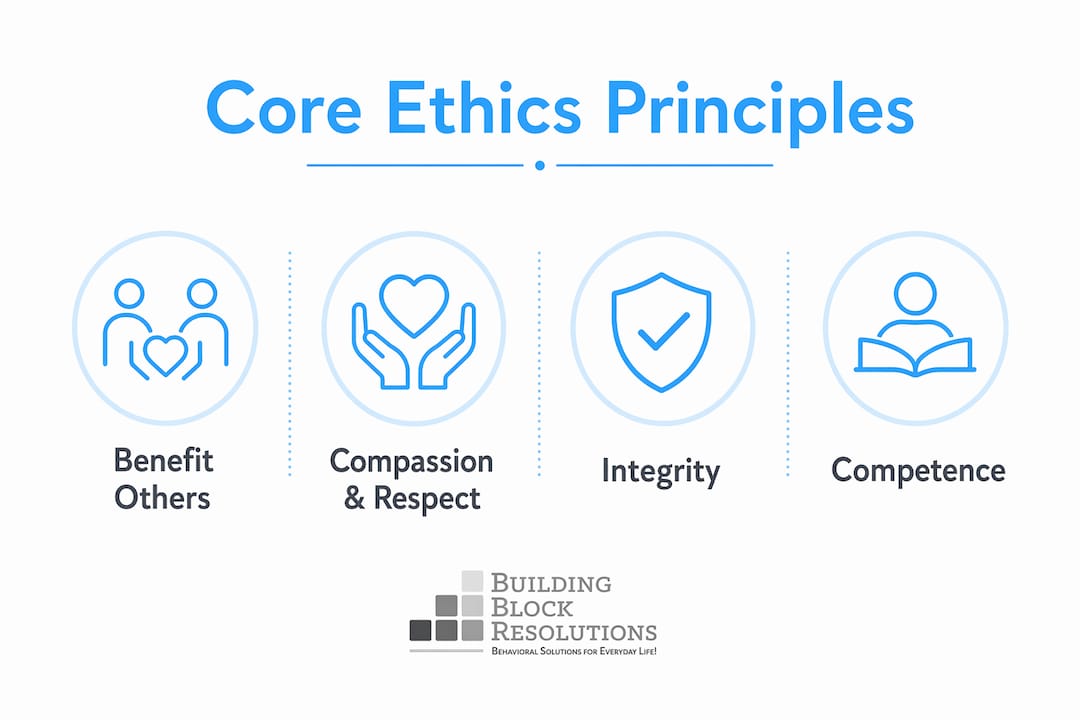
Treat others with compassion, dignity, and respect
This principle extends beyond politeness. It requires behavior analysts to honor the autonomy of clients, recognize cultural context, and avoid any practice that demeans or marginalizes the people they serve. Dignity is not a soft concept in this framework. It is an enforceable professional obligation.
Behave with integrity
Integrity covers honesty in documentation, transparency with families, and avoiding conflicts of interest. A behavior analyst who backdates session notes or withholds unfavorable data from a treatment review fails this standard. The code requires practitioners to represent their work accurately, even when accuracy is uncomfortable.
Ensure competence
Competence means providing only the services you are qualified to deliver and actively pursuing professional development to maintain that qualification. The field evolves. An analyst who stopped updating their knowledge after initial certification is not meeting this standard.
Pro Tip: When the code does not specify an exact rule for a situation, return to the four core principles. Ask which principle is most at stake and reason from there. This is the approach the 2022 code was designed to support.
What are the most common ethical violations in behavior analysis?
Documentation and supervision failures are the most frequent ethical violations behavior analysts face in 2026. These failures often reflect systemic pressures rather than deliberate misconduct. Recognizing the patterns helps practitioners address root causes before violations occur.
-
Missed signatures and incomplete records. Session notes missing required signatures or lacking sufficient detail create legal and ethical exposure. These errors often accumulate during high-volume periods when documentation feels secondary to direct service.
-
Backdating records. Backdating is one of the clearest integrity violations in the field. It misrepresents when services occurred and undermines the accuracy of the clinical record.
-
Inadequate supervision. Supervision failures include insufficient contact hours, informal oversight that does not meet BACB standards, and supervisors who sign off on work they have not reviewed. Inadequate oversight ranks among the top systemic risks in behavior analytic organizations today.
-
High caseload pressure. Large caseloads increase the probability of every category of ethical error. When analysts are stretched thin, documentation suffers, supervision quality drops, and clinical decisions get made with less information than they require.
-
Digital communication missteps. The Ethics Code covers all professional activities including social media posts, public statements, and online interactions. Sharing client information in a private message or making unqualified public claims about treatment outcomes both fall within the code’s scope.
-
Dual relationships. Accepting gifts, forming personal friendships with client families, or entering business arrangements with supervisees creates conflicts of interest that compromise professional judgment.
Pro Tip: Build a brief ethics check into your weekly supervision agenda. Even five minutes reviewing recent documentation and flagging potential dual relationship concerns builds the habit of ethical vigilance before problems escalate.
How do behavior analysts navigate ethical dilemmas in complex situations?
Ethical decision-making in ABA requires a structured process, not a gut reaction. Practitioners who treat ethics as a checklist are poorly equipped for the ambiguous situations that real practice generates. A principles-based approach demands active reasoning at every step.
The core steps in structured ethical decision-making are:
- Identify the ethical issue. Name the specific principle or code section at stake before doing anything else.
- Gather relevant information. Collect facts about the client, the context, organizational policies, and applicable regulations.
- Analyze stakeholder interests. Consider how the decision affects the client, family members, supervisees, and the broader organization.
- Generate multiple options. Avoid settling on the first solution that seems acceptable. Premature closure on ethical decisions is a documented pitfall that reduces decision quality.
- Evaluate each option against core principles. Ask which option best serves the client’s welfare, preserves dignity, maintains integrity, and stays within your competence.
- Implement and document. Act on the chosen course and record your reasoning, not just your action.
- Review the outcome. Ethical decisions are not final. Revisit the situation to assess whether the chosen path produced the intended result.
“Ethics cannot be reduced to IRB approval or checklists; ethical responsibility persists through design and interpretation phases.” — Professor RJ Starr
Dr. Kenneth Pope emphasizes that active ethical vigilance requires awareness of personal blind spots and a genuine problem-solving attitude. Emotional reactions to difficult cases are normal. Acting on them without deliberate reasoning is where ethical errors begin. Practitioners who build structured reflection into their daily practice make better decisions under pressure than those who rely on instinct alone.
The importance of ethics in psychology and behavior analysis converges on this point: ethical competence is a skill, not a personality trait. It develops through practice, feedback, and honest self-examination. Reviewing behavior analytic research methodology alongside ethics training deepens a practitioner’s ability to evaluate evidence and apply it responsibly.
What builds an ethical culture in behavior analysis organizations?
Ethical culture does not emerge from a policy document. It develops through consistent leadership behavior, structured team practices, and systems that make ethical conduct the path of least resistance.
Regular ethics discussions embedded in supervision build practical fluency in navigating dilemmas. Teams that talk about ethics weekly develop a shared vocabulary and a lower threshold for raising concerns. Organizations that discuss ethics only during annual compliance training produce practitioners who treat the code as a bureaucratic requirement rather than a professional commitment.
The table below contrasts two organizational approaches to ethics integration:
| Approach | Characteristics |
|---|---|
| Compliance-only model | Ethics reviewed at onboarding and annual training; code treated as a rule list; violations addressed reactively |
| Principles-based culture | Ethics embedded in weekly supervision; code used as a reasoning tool; concerns raised proactively; leadership models ethical dialogue |
Clear documentation workflows reduce system-based errors. When analysts have standardized templates, defined signature protocols, and realistic caseload expectations, documentation quality improves without requiring heroic individual effort. Documentation failures often stem from rushed workflows and high caseloads rather than malicious intent. Fixing the system fixes the behavior.
Leadership plays a decisive role. When senior analysts take ethical questions seriously in team meetings, ask hard questions about their own decisions, and acknowledge uncertainty openly, they signal that ethical seriousness is a professional norm. When leaders dismiss ethical concerns as obstacles to productivity, practitioners learn to stay quiet.
Pro Tip: Assign a rotating “ethics moment” at the start of each team meeting. Ask one person to bring a brief scenario from their caseload for group discussion. This practice builds ethical reasoning skills and normalizes the conversation.
Ethical practices in behavior therapy also extend to how practitioners represent themselves publicly. Social media profiles, conference presentations, and parent communications all fall within the code’s scope. Training teams on digital communication standards is not optional. It is part of ensuring competence in a connected professional environment.
Key Takeaways
Ethics in behavior analysis is a principles-based framework requiring active reasoning, not passive compliance, and it governs every domain of professional practice from direct care to digital communication.
| Point | Details |
|---|---|
| Four core principles | Benefit others, treat with dignity, behave with integrity, and ensure competence guide all decisions. |
| Common violations | Documentation errors and supervision failures are the most frequent risks, often driven by high caseloads. |
| Structured decision-making | Identify the issue, analyze stakeholders, generate options, and review outcomes to navigate dilemmas well. |
| Ethical culture | Embedding ethics in weekly supervision builds fluency and lowers the threshold for raising concerns. |
| Beyond compliance | Ethical responsibility extends through every phase of practice, including digital communication and public representation. |
Ethics in behavior analysis requires more than good intentions
I have worked alongside behavior analysts who genuinely care about their clients and still make ethical errors. That combination used to surprise me. Now I understand it as the central challenge of the field.
Good intentions do not substitute for structured reasoning. The shift the 2022 BACB Ethics Code made from rules to principles was not a softening of standards. It was an acknowledgment that real practice is too complex for a checklist to cover. Ethics beyond compliance requires ongoing judgment, willingness to sit with discomfort, and asking difficult questions that regulatory mandates do not require you to ask.
The practitioners I trust most are the ones who say “I’m not sure this is right” out loud in team meetings. That kind of ethical humility is not a weakness. It is the clearest sign that someone is taking the code seriously as a reasoning framework rather than a liability shield.
Complacency with procedural safeguards is the real risk. An analyst who has never had a complaint filed against them may believe their ethics are solid. But ethical maturity means continuous self-interrogation, not the absence of consequences. The field needs practitioners who pursue that maturity deliberately, through peer dialogue, supervision, and honest reflection on their own blind spots.
— Jennifer
Ethical practice starts with the right foundation
Behavior analysts committed to ethical practice need more than good intentions. They need structured knowledge, ongoing training, and access to resources that keep their skills current.

Buildingblockresolutions supports practitioners and families through evidence-based resources designed to strengthen competence and ethical fluency at every level. From professional webinars covering current BACB standards to practical guides on ABA therapy fundamentals, the resources available reflect over 20 years of applied experience. Whether you are building supervision systems, coaching parents, or refining your own ethical reasoning, Buildingblockresolutions offers the depth and credibility your practice deserves.
FAQ
What is the role of ethics in behavior analysis?
Ethics in behavior analysis provides the principled framework that guides all professional decisions, ensuring practitioners prioritize client welfare, dignity, integrity, and competence in every service domain.
What are the four core principles of the 2022 BACB Ethics Code?
The four principles are: benefit others, treat others with compassion and dignity, behave with integrity, and ensure competence. These principles replace a purely rules-based approach with values-driven reasoning.
What are the most common ethical violations for behavior analysts?
Documentation failures and supervision deficiencies are the most frequent violations, often linked to high caseload pressures and rushed workflows rather than deliberate misconduct.
How do ethical considerations in behavior analysis apply to digital communication?
The BACB Ethics Code covers all professional activities, including social media posts and public statements, requiring accuracy, confidentiality, and transparency in every digital interaction.
How does ethical decision-making differ from simply following the code?
Following the code addresses known situations. Ethical decision-making applies the four core principles to novel or ambiguous situations where no specific rule exists, requiring active reasoning and stakeholder analysis.
0 Comments