TL;DR:
- A BCBA resume proves your clinical impact, supervision scope, and ethical compliance through measurable outcomes.
- Tailoring each section, adding keywords, and quantifying achievements increase your chances of securing interviews.
A BCBA resume is a marketing document that proves your clinical impact, supervision scope, and ethical compliance through measurable outcomes. This bcba resume writing guide covers every section you need, from a metrics-driven professional summary to ATS-ready keyword placement, so hiring managers see your value before the first interview. Whether you are entering the field or targeting a clinical director role, the difference between a callback and silence often comes down to how well your resume translates daily practice into documented results. The sections below give you a practitioner-focused roadmap built for 2026.

What are the essential sections of a successful BCBA resume?
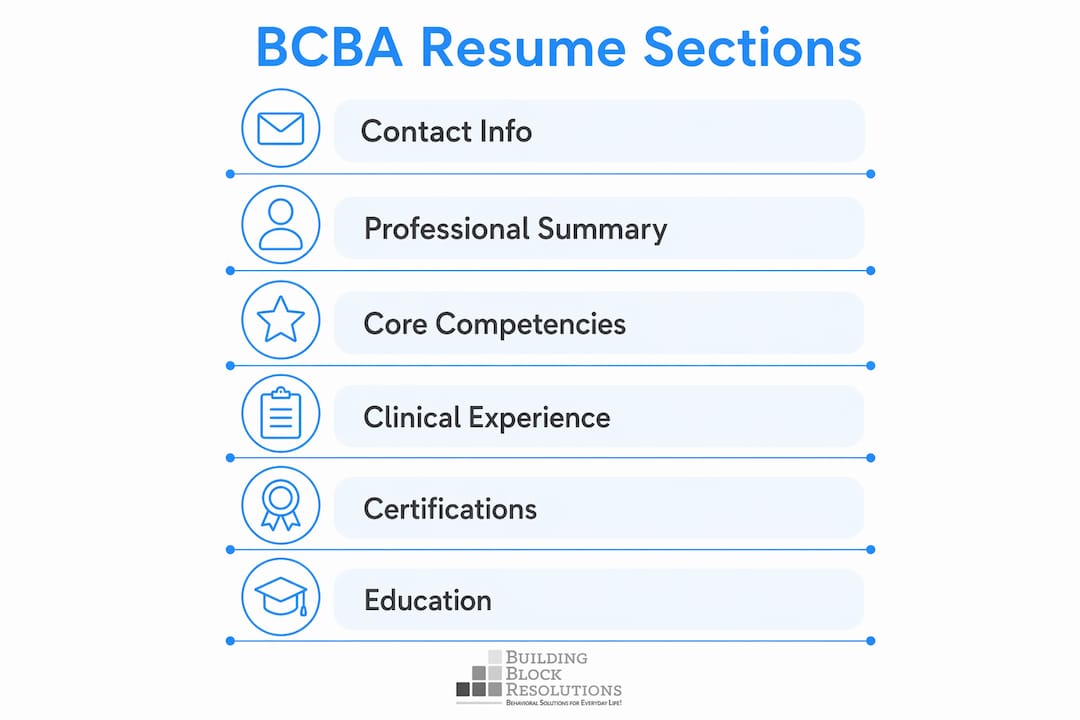
A well-structured BCBA resume contains six core sections, and each one serves a specific purpose for the reader. Missing even one of them signals inexperience to a clinical director scanning dozens of applications.
Contact header
Your header must include your full name, phone number, professional email, LinkedIn URL, and your BCBA certification number. Including your BACB number prominently lets hiring teams verify your credentials through the BACB registry in seconds. Omitting it creates a processing delay that can cost you the interview.
Professional summary
The professional summary is a 3–4 sentence paragraph placed directly below your header. It should name your setting, your target population, your core competencies, your supervisory scope, and at least one quantified outcome. A strong example reads: “Board Certified Behavior Analyst with 5 years of experience delivering EIBI in clinic settings for children ages 2–8. Supervised a team of 6 RBTs using Behavior Skills Training, improving group treatment integrity from 74% to 91% over 8 weeks.” That level of specificity is what separates a summary from an objective statement.
Pro Tip: Never use an objective statement on a BCBA resume. Objective statements describe what you want. Hiring managers want to know what you deliver.
Core competencies
This section is a keyword grid of 12–18 skills pulled directly from the job description. Include terms like VB-MAPP, ABLLS-R, AFLS, Behavior Skills Training, functional behavior assessment, and caregiver training. ATS keyword matching is critical, and focusing on 3–5 key phrases per job posting prevents stuffing while covering the filters that matter.
Clinical experience, certifications, and education
List clinical roles in reverse chronological order with 4–6 bullet points per position. Use reverse-chronological order and start every bullet with an action verb. Your certifications section should list your BCBA credential, any state licenses, and your BACB certification number again for redundancy. Education should name your degree, institution, and any coursework directly relevant to behavior analysis.
| Resume section | What to include |
|---|---|
| Contact header | Name, phone, email, LinkedIn, BACB certification number |
| Professional summary | Setting, population, competencies, supervision scope, one metric |
| Core competencies | 12–18 ATS keywords from the job description |
| Clinical experience | Reverse-chronological roles with 4–6 quantified bullets each |
| Certifications and licenses | BCBA credential, state licenses, BACB number |
| Education | Degree, institution, relevant coursework |
How to write impactful resume bullets for clinical and supervisory achievements
Generic duty lists are the single biggest weakness on BCBA resumes. Hiring managers prioritize candidates who show supervision outcomes and rubric-based coaching strategies, not candidates who simply list “supervised RBTs.”
The most reliable formula for a strong bullet is: action verb + procedure + setting or population + metric + timeframe + supervision or system context. Every element earns its place. Remove any element and the bullet loses specificity.
Here are four examples that apply the formula correctly:
- Designed and implemented discrete trial training programs for 12 children with ASD in a clinic setting, achieving an average of 85% skill mastery across communication targets within 6 months.
- Supervised 8 RBTs using Behavior Skills Training and rubric-based evaluations, improving treatment integrity from 71% to 90% over 6 weeks.
- Conducted functional behavior assessments for 15 school-age clients, reducing target problem behaviors by an average of 60% within the first 10 weeks of intervention.
- Led caregiver training sessions for 20 families using behavioral skills training protocols, resulting in a 40% increase in parent-reported treatment adherence at home.
The most cited resume mistake among BCBA applicants is confusing activity with impact. Writing “conducted FBAs” tells a hiring manager what you did. Writing “conducted FBAs for 15 clients, reducing problem behaviors by 60% in 10 weeks” tells them what your work produced. Recruiters fund outcomes, not activities.
Operational metrics matter just as much as clinical ones. Recruiters value metrics beyond clinical hours, including billable efficiency and treatment integrity improvements. A bullet noting a 15% increase in billable adherence signals that you understand the business side of ABA practice, which is exactly what clinical directors look for in senior candidates.
Pro Tip: Read the job posting carefully before writing bullets. Match your metrics to the priorities named in the description. A school-based role values IEP collaboration data. A clinic role values mastery rates and parent satisfaction scores.
How to tailor your BCBA resume for different settings and pass ATS filters
Tailoring your professional summary to your target setting maximizes impact with interviewers. A one-size resume rarely clears both the ATS filter and the clinical director’s desk.
Setting-specific priorities to address in your summary and bullets:
- Clinic (EIBI focus): Highlight skill mastery rates, parent satisfaction scores, and early intervention outcomes for children ages 2–6.
- School-based: Emphasize IEP goal alignment, interdisciplinary collaboration with special education teams, and behavior support plan implementation.
- Telehealth: Feature parent coaching outcomes, technology fluency (video platforms, data collection apps), and remote supervision competencies.
- Leadership or program director roles: Lead with program-level metrics such as audit pass rates, staff retention, and training curriculum design.
ATS compatibility depends heavily on formatting and keyword placement. Standard formatting means a single-column layout, standard fonts like Calibri or Arial at 10–12 points, and no tables, text boxes, or columns in the header or footer. Older ATS platforms miss content placed in those areas entirely.
| Resume element | ATS-friendly approach | Common mistake |
|---|---|---|
| Contact info | Body text, not header or footer | Placing in header causes parsing failure |
| Keywords | 3–5 exact phrases from job description | Stuffing 20+ terms reads as spam |
| Fonts | Calibri, Arial, Times New Roman | Decorative fonts cause character errors |
| Layout | Single column | Multi-column layouts confuse ATS parsers |
| File format | .docx or .pdf per employer instructions | Wrong format can block submission |
Resume length follows experience. One page suits candidates with fewer than 3 years of post-certification experience. Two pages are appropriate for BCBAs with extensive supervisory history, program leadership, or specialty credentials. Omitting terms like VB-MAPP or AFLS causes automatic filtering before a human ever reads your application.
Pro Tip: Copy the job description into a text document and highlight every ABA-specific term. Then check your resume against that list. Any gap is a keyword you need to add.
What common mistakes should BCBA applicants avoid?
Most resume errors are fixable once you know what to look for. The following mistakes appear repeatedly across BCBA applications and each one reduces your interview rate.
- Using an objective statement. Objective statements focus on what you want from the employer. Replace every objective statement with a metrics-driven professional summary.
- Omitting your BACB certification number. Omitting this number creates barriers to processing your application. Add it to both the header and the certifications section.
- Listing duties instead of outcomes. “Responsible for writing behavior intervention plans” tells a hiring manager nothing about your effectiveness. Quantify every bullet.
- Failing to explain employment gaps. A brief parenthetical note such as “(parental leave, January–August 2024)” prevents assumptions and keeps the reader focused on your qualifications.
- Dense paragraphs in the experience section. Paragraphs slow readers down. Bullet points let clinical directors scan your impact in under 30 seconds.
- Ignoring ATS keyword requirements. A resume without tailored keywords gets rejected automatically. Customize the core competencies section for every application.
Pro Tip: Print your resume and time yourself reading it aloud. If you cannot absorb the key facts in 30 seconds, a hiring manager cannot either. Tighten every bullet until the impact is immediate.
How can BCBAs use their resume to advance beyond entry-level roles?
A resume for a senior BCBA or clinical director role must demonstrate program-level thinking, not just caseload management. The career impact of BCBA certification grows significantly when your resume reflects leadership and systems-level contributions.
Specific elements that signal readiness for advancement:
- Supervisory scope: Name the number of RBTs and trainees you supervised, the supervision model you used (BST, performance-based feedback), and measurable independence outcomes.
- Program outcomes: Include audit pass rates, on-time documentation percentages, and caregiver satisfaction data. Operational metrics like audit pass rates show understanding of business and clinical practice together.
- Training curricula: Note any staff training programs you designed, including the number of staff trained and competency outcomes.
- Continuing education and specialty credentials: List continuing education units, specialty certifications, and any ethics training completed beyond BACB requirements.
- Interdisciplinary collaboration: Name the disciplines you worked alongside (speech-language pathology, occupational therapy, special education) and describe the outcomes of that collaboration.
- Ethics and compliance: Mention any ethics committee participation, compliance audits passed, or ethics training you delivered to staff.
Building a personal brand around a specific population or setting (early intervention, school-based, telehealth) makes your resume memorable. Building your professional network alongside a targeted resume creates a consistent professional identity that hiring committees recognize and trust. Candidates who pair a focused resume with active professional visibility move into leadership roles faster than those who rely on credentials alone.
Key takeaways
A BCBA resume succeeds when it presents clinical work as measurable impact, uses ATS-ready keywords from the job description, and tailors every section to the specific setting and role.
| Point | Details |
|---|---|
| Lead with a professional summary | Replace objective statements with a 3–4 sentence summary that names your setting, population, and at least one quantified outcome. |
| Quantify every bullet | Use the action verb + procedure + metric + timeframe formula to show impact, not just activity. |
| Include your BACB number | Add your certification number to both the header and certifications section to speed up verification. |
| Tailor keywords by setting | Pull 3–5 exact ABA terms (VB-MAPP, ABLLS-R, AFLS) from each job description to pass ATS filters. |
| Show program-level impact | Senior roles require operational metrics like audit pass rates, staff training outcomes, and billable adherence data. |
What I have learned from years of watching BCBA resumes succeed and fail
The resumes that earn callbacks share one quality: they read like behavioral data, not career histories. Every bullet answers the question a clinical director is actually asking. “What did this person produce, and can they produce it here?”
The most common mistake I see is candidates treating their resume as a record of where they have been. A resume is a prediction of what you will do next. When you write “supervised 8 RBTs and improved treatment integrity from 71% to 90% in 6 weeks,” you are not just describing the past. You are telling the next employer exactly what they can expect from you.
Tailoring language to the setting matters more than most candidates realize. A telehealth role values parent coaching fluency and technology competency. A school-based role values IEP alignment and collaboration with multidisciplinary teams. Sending the same resume to both settings signals that you have not thought carefully about the role. Clinical directors notice that immediately.
Ethics and compliance visibility also carry more weight than candidates expect. Mentioning ethics committee participation or a clean compliance audit is not boasting. It is evidence that you operate within the professional standards the BACB requires. Hiring managers at reputable organizations treat that as a baseline requirement, not a bonus.
Update your resume every six months, not just when you are job searching. The habit of documenting outcomes as they happen means you never scramble to reconstruct data from memory. Your resume becomes a living record of your clinical growth, and that consistency shows.
— Jennifer
Supporting your BCBA career growth with Buildingblockresolutions
Buildingblockresolutions has supported behavioral analysts and families for over 20 years, building a reputation grounded in evidence-based practice and measurable outcomes. If you are working toward a BCBA role or advancing into clinical leadership, the professional development resources at Buildingblockresolutions offer practical guidance for every stage of that path.
The services available at Buildingblockresolutions include career counseling tailored to behavioral analysis professionals, telehealth support, and training resources aligned with current BACB standards. For analysts exploring career counseling options, Buildingblockresolutions provides structured guidance that connects your resume goals to your long-term professional identity. The team brings the same commitment to measurable progress that defines great ABA practice.
FAQ
What should a BCBA professional summary include?
A BCBA professional summary should name your setting, target population, core competencies, supervisory scope, and at least one quantified outcome in 3–4 sentences. Summaries with metrics like supervising 8 RBTs and improving treatment integrity from 71% to 90% over 6 weeks capture hiring manager attention far more effectively than generic descriptions.
How long should a BCBA resume be?
One page suits BCBAs with fewer than 3 years of post-certification experience, while two pages are appropriate for candidates with extensive supervisory history or program leadership roles. Prioritize depth of impact over length.
Do I need to include my BACB certification number on my resume?
Yes. Including your BACB certification number in both the header and certifications section speeds up verification through the BACB registry and is viewed positively by hiring managers. Omitting it slows application processing.
How do I make my BCBA resume pass ATS filters?
Use a single-column layout with standard fonts, place contact information in the body text rather than the header or footer, and include 3–5 exact ABA curriculum keywords from the job description such as VB-MAPP, ABLLS-R, or AFLS. Omitting these terms causes automatic rejection before a human reviews your application.
What metrics should I include in BCBA resume bullets?
Include treatment integrity percentages, behavior reduction rates, skill mastery rates, number of RBTs supervised, caregiver training outcomes, and operational data like billable adherence or audit pass rates. Experienced recruiters look beyond clinical hours to operational metrics that distinguish top candidates from the rest of the field.
0 Comments